Comprehensive Plan
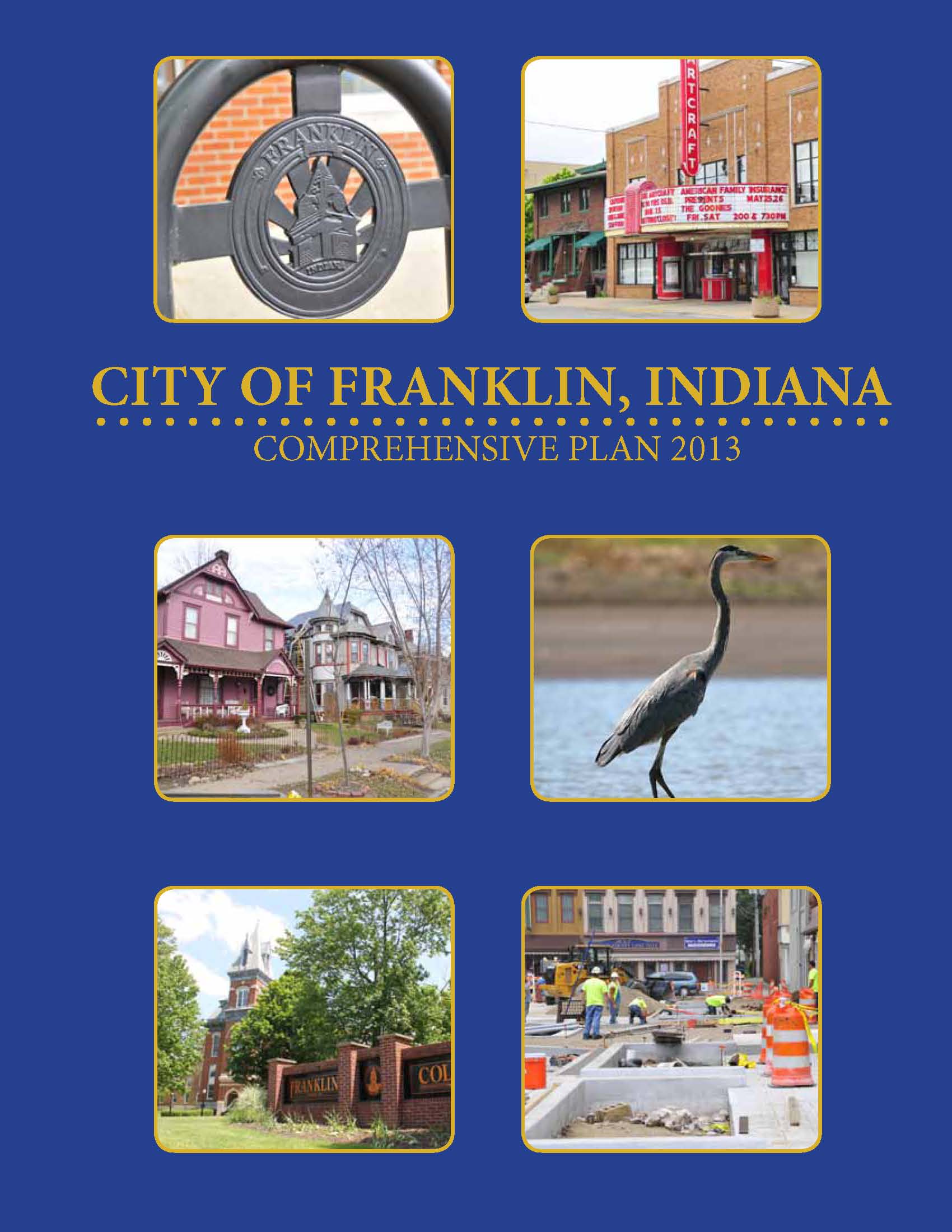
Click here to view the 2013 Comprehensive Plan
The 2013 City of Franklin Comprehensive Plan has been officially adopted by the Franklin Common Council on October 7, 2013.
CD-ROM copies of the plan are available at the Department of Community Development or a fee of $10.00. Contact by phone at: 317-736-3631 or 877-736-3631 by Mail at: 70 E. Monroe Street, Franklin, IN 46131 or by email at mailto:klinke@franklin.in.gov.
Thank you for your continued interest in the City of Franklin Planning Process.
Economic Development Commission
Economic Development Initiatives
Economic Development efforts for the City of Franklin are coordinated by the City's Community Development Department.
2025 Economic Development Commission Members:
| Member Name | Appointed By | Term |
| Josh DeArmitt- President | Mayor | Term Ends 2-1-2026 |
| Shawn Taylor- Vice President | City Council | Term Ends 2-1-2026 |
| Eric Leugers-Secretary | Mayor | Term Ends 1-1-2027 |
| H. Lee Hodgen | Mayor | Term Ends 2-1-2028 |
| Lisa Jones | County Council | Term Ends 2-1-2028 |
Economic Incentives Overview
Within the state of Indiana, several economic incentives are allowed to be considered to assist companies with either locating to Franklin or expanding their existing businesses. These economic incentives include economic development revenue bonds, tax increment financing (TIF), lease/purchase agreements, and tax abatements. When considering a request for any economic incentives, the Economic Development Commission and City Council will consult the criteria outlined for tax abatement requests according to Indiana Code and all requirements of Indiana law.
Tax Abatements
A tax abatement is a temporary relief of the tax burden on eligible projects in specific areas. Generally, tax abatement is used (1) as an economic inducement for directed development; (2) to increase the eventual tax base for all government units; (3) to diversify the economy and employment; and (4) to increase non-property tax income to some government units.
Both real property and personal property (manufacturing equipment) are eligible for tax abatement under Indiana law. In order to receive abatement, the real property must be either an industrial, commercial, or one of three types of housing development projects. Eligible housing projects include senior citizen housing, housing for the disabled, and housing benefiting low or moderate income populations. Taxes on land and used machinery not new to the State of Indiana are not eligible for tax abatement.
During the first year of the abatement period, 100% of the increase in the evaluation of abateable property in the development area is abated. Thereafter, the percentage of the abatement declines annually according to the schedules established by Indiana law.
To print the tax abatement application, please click HERE
Economic Development Fees
Vacant Building Tax Abatement
The Vacant Building Tax Abatement Program is available for buildings that (1) are zoned commercial or industrial; (2) is unoccupied for at least one year before the owner of the building or a tenant of the owner occupies the building, as evidenced by a valid certificate of occupancy, paid utility receipts, executed lease agreements, or any other evidence of occupation that the department of local government finance required.
The deduction is 100% of the assessed value of the building for up to three years. City Council can limit the dollar amount of the deduction to less than this amount if they choose. The vacant building deduction is specifically limited to real estate improvements; therefore personal property can also be abated.
Economic Development Revenue Bonds
These types of bonds are generally tax-exempt bonds with low rates of interest. The bonds may be used to finance economic development projects such as industrial facilities or multifamily housing complexes.
The use of economic development revenue bonds entails the city acting as a conduit for a) the endorsement of the project, and b) authorization for the respective company to issue the bonds. These endorsements by the City do not in any way abate, expend, or forgive any tax dollars.
Tax Increment Financing (TIF)
A TIF involves utilizing additional property tax revenue from private development within a designated area for financing public improvements. The public improvements financed by the TIF are needed to induce new development or are necessitated by new development.
Lease & Purchase Agreements
A Lease & Purchase Agreement allows a city through its Redevelopment Commission and Authority to purchase real and personal property for an economic development project which is then leased or purchased by the project owner.
Historic Tax Credits
- Aspire Economic Development + Chamber Alliance: www.aspirejohnsoncounty.com
- Franklin Development Corporation: www.franklindevelopmentcorporation.org
- Franklin Chamber of Commerce: www.franklincoc.com
- Discover Downtown Franklin: www.DiscoverDowntownFranklin.com
- Johnson County Public Library: http://www.pageafterpage.org/johnson-county-community-information/
Redevelopment Commission
2025 Redevolpment Commission Members:
| Member Name | Appointed By | Term |
| Richard Wertz, President | Mayor | Term Ends 12-31-2025 |
| Anne McGuinness, Vice-President | City Council | Term Ends 12-31-2025 |
| BJ Deppe, Secretary | Mayor | Term Ends 12-31-2025 |
| Josh Prine | City Council | Term Ends 12-31-2025 |
| Paul Buening |
Mayor | Term Ends 12-31-2025 |
| Deb Gill | School Board Representative | Non-Voting Member |
| Ellen Fredbeck-Ramirez, Attorney | RDC | Yearly Contract |
The Redevelopment Commission meets the 3rd Tuesday of each month at 8:00 a.m. in the Council Chambers at City Hall - 70 E. Monroe Street.
The duties and powers of the Redevelopment Commission are regulated by Indiana Code 36-7-14.
To view the 2024 Tax Impact Analysis on Other Taxing Units, click here.
To watch a video explaining how TIF works in Indiana, click here.
City Master Plans
Here is a list of current City plans for Franklin, IN:
Public Arts Advisory Commission
The Commission has created a list of local artists and their contacts. To be added to this list, please download this document and email to dmonson@franklin.in.gov
A copy of the current list of local artists can be found HERE.
The Commission is now accepting applications from artists for artwork for the 2025 banner art series. Please download this document and email to dmonson@franklin.in.gov
2025 Public Arts Advisory Commission Members:
| Member Name | Appointed By | Term |
| Ken Kosky, President | Mayor | 1/1/25-12/31/26 |
| Joshua Hendrickson, Vice-President | Mayor | 1/1/24-12/31/25 |
| Victoria Ratliff, Secretary | Mayor | 1/1/25-12/31/26 |
| Chrissy Robertson | Mayor | 1/1/24-12/31/25 |
| Dave Windisch | Mayor | 1/1/24-12/31/25 |
| Vickie Noblitt | Mayor | 1/1/21-12/31/25 |
| Danny Causey | Mayor | 1/1/24-12/31/25 |
| Christy Locke | Mayor | 1/1/25-12/31/26 |
| Nick Crisafulli | Mayor | 1/1/24-12/31/25 |
Krista Linke, Community Development Director
Alex Getchell, Senior Planner 1
Dana Monson, Community Development Specialist
The Public Art Advisory Commission meets on the second Thursday of the month at 8:00 a.m. at City Hall, 70 E. Monroe St., Franklin, IN 46131.
Upcoming Events
- Economic Development Commission03/10/268:00 am - 9:00 am
- Public Art Advisory Commission03/12/268:00 am - 9:00 am
- Redevelopment Commission Meeting03/17/268:00 am - 11:59 pm
- Public Art Advisory Commission04/09/268:00 am - 9:00 am
- Redevelopment Commission Meeting04/21/268:00 am - 11:59 pm
Contact Us
Director of Community Development
- Business: (877) 736-3631
- Business Fax:
(317) 736-5310 - Staff Directory
- Hours: 8:00 am - 4:00 pm
Monday - Friday